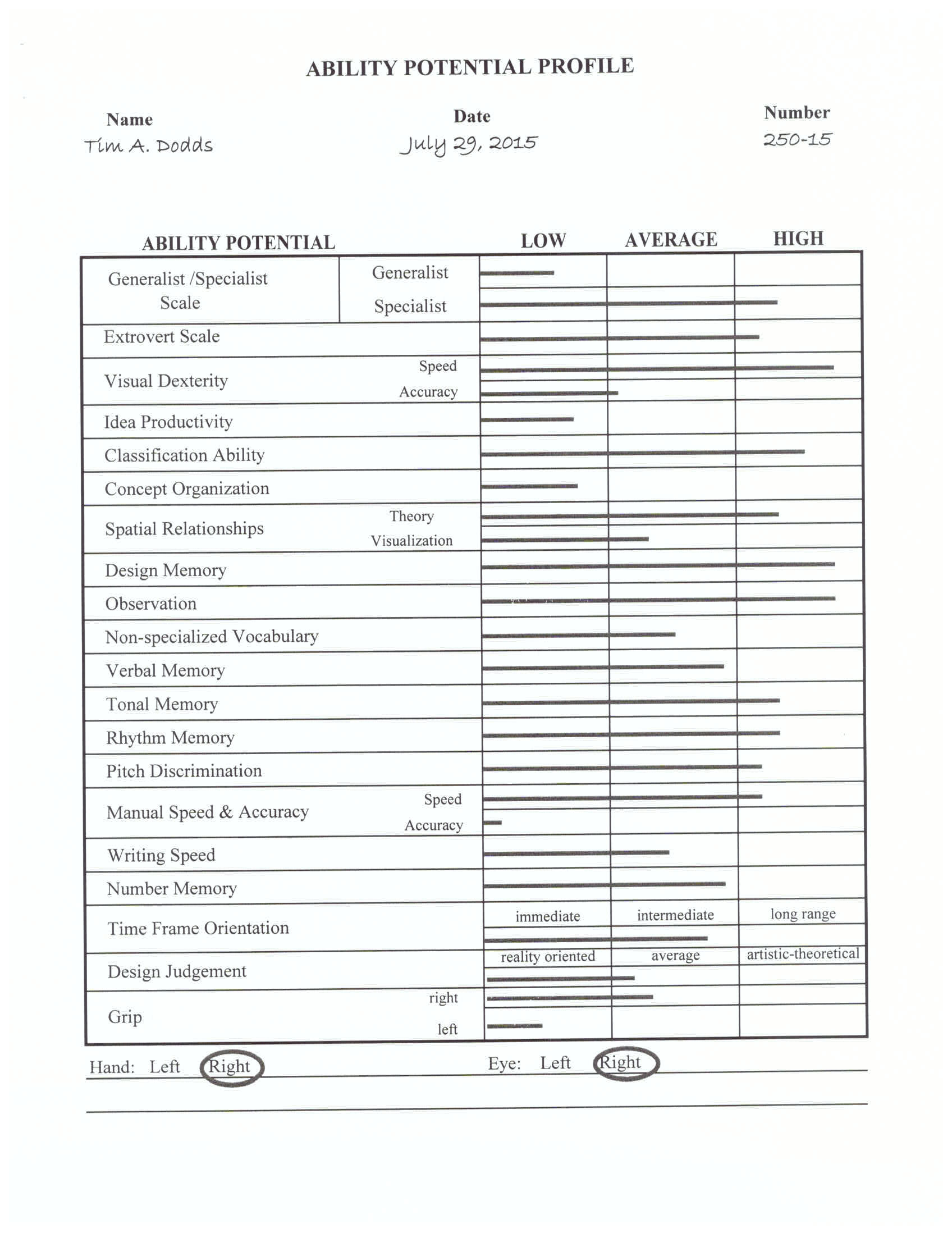
In 2015 I took the Ability Potentials aptitude battery -- a set of timed, work-sample tests that measure natural aptitudes rather than knowledge or interests. What follows is the report written for me afterward, along with my score profile. I've kept it here as a snapshot of who I was measured to be at the time.
At a glance
The scores that stood out, and the way the report framed them:
High: Classification Ability (problem-solving / diagnostic thinking), Spatial Relationships Theory, Design Memory, Observation, all three music aptitudes (Tonal Memory, Rhythm Memory, Pitch Discrimination), and a Specialist, Extrovert working style.
Average: Spatial Relationships Visualization — unusually, since most people land clearly high or low.
Low: Idea Productivity (a plus for concentration) and Concept Organization (a preference for jumping to conclusions over step-by-step method).
The report's one-line summary of an ideal fit: working as an expert in a fast-paced job, perhaps involving some "hands-on" elements, where you must "think on your feet" and face a number of unpredictable situations or problems.
The report
Your life, your work, and your hobbies will be heavily influenced by your very high Classification Ability and your Specialist Extrovert nature. Classification Ability combines with your other strengths to support a wide variety of careers -- ranging from detective work or sound engineering to "quasi-science" fields such as environmental science or air traffic control to owning a vineyard or goat farm where you focus on organic products to refereeing or coaching a sport. We could describe the ideal job situation for you as: working as an expert in a fast-paced job, perhaps involving some "hands-on" elements, where you must "think on your feet" and face a number of unpredictable situations or problems. To the extent you can be "out and about," you will be even happier.
The single most important aptitude in your overall profile is Classification Ability, where you score in the high range. This is a very powerful aptitude that demands usage and is often a source of difficulty for people high in it. Classification Ability is the problem-solving, critical, diagnostic thinking aptitude. People who have a high score can look at bits of information that, on the surface, may appear unrelated. They quickly analyze and interpret the data, looking for the implications and important issues inherent within the given facts. This is an excellent aptitude for a person who must "think on the fly" and generate solutions to problems very quickly. It also suggests that you will most likely become bored and restless if you do not have sufficient "problem-solving and advice-giving" outlets. Many people high in this aptitude become hobby drifters, or job drifters. The front-end aspects of a skill or issue are fun -- figuring out how to do something, how the parts fit together, where the problems exist, what better solutions are available. Once the problem is solved, however, this person wants to drift off to a new situation or skill or area of inquiry. Other negative traits such as procrastination, impatience, a critical nature, and a tendency towards depression often characterize someone high in Classification Ability.
If you combine Classification Ability with something like insurance, you have the insurance fraud investigator. With engineering, it might be the aircraft accident investigator. With accounting, it may find a place in the government investigative agencies in any department (the IG). With sciences, it becomes the forensic scientist. With criminal justice, it becomes the standard detective, or criminal investigator. With social work, it becomes the child abuse investigator or federal probation officer. Educational research might investigate how standardized testing is impacting the learning process. Health care research might study how current Medicare/Medicaid programs are impacting the use of generic drugs. In medical fields, Classification Ability is used in diagnosing the causes of disease and the proper treatment to prescribe. Thus you can see the many ways in which this aptitude can find a place within a variety of fields or industries.
In your case, your high Classification Ability combines with your scores in Spatial Relationships Theory, Spatial Relationships Visualization, and the two visual aptitudes to support certain "quasi-science" fields that offer elements of unpredictability and a number of problems to solve. Let's look at each of these aptitudes.
You score in the high range in Spatial Relationships Theory and in the average range in Spatial Relationships Visualization. Your Spatial Relationships Visualization is too low for us to recommend actual hard-core sciences such as becoming a research chemist or an engineer, but your average score in Spatial Relationships Visualization along with your Classification Ability, Design Memory and Observation would support many allied health and technical fields. Along these lines, think of: sports nutrition, forestry, aquaculture (fish farming), dietetics, forensic science, fraud or arson investigation, physical therapy, environmental sciences, occupational therapy, soil sciences, public health, robotics, and alternative/herbal medicine.
Spatial Relationships Theory is an ability to see abstract relationships in mathematical systems and a gift for understanding abstract forces. Think of the forces that hold a molecule together, or the forces that lead to earthquakes and volcanic eruptions. Other abstract yet scientific forces are wind, tides, gravity, electricity, magnetism -- all of these are non-tangible forces. Spatial Relationship Theory fits into fields such as astronomy, physics, and pure mathematics. It is also used in the financial arena for statistical analysis, trend analysis, math modeling tasks, demographic studies, and social science research.
Spatial Relationships Visualization is the three-dimensional aptitude. It is the ability to "see" in three dimensions, given only two. For example, the blueprint of a house is two dimensions but the actual house has three dimensions. People who are structural (high in Spatial Relationships Visualization) can look at the blueprint and actually imagine the third dimension. People low in this aptitude prefer working in the world of ideas, words, and people -- the intangible world. Most people are either high or low in this aptitude. Your score in the average range is unusual. As we noted above, it is high enough to support many "blended" fields which allow you to work with people and words but also have some tangible outcomes.
In the visual area, you score in the high range in both Design Memory and Observation. Observation relates to the ability to work with and recall small visual details while Design Memory is a more big picture visual talent. Both of these aptitudes are useful in jobs that rely upon visual input and visual messages -- whether in the creation of the material or the use of it. Careers in laboratory work, inspection, botanical and biological sciences use these gifts, as do jobs that involve creating and working with maps or photos, working in film technologies and printing, working with sketches and drawings, architectural blueprints and desktop publishing systems, and so on.
Turning now to other areas, you have high scores in all three music aptitudes -- which is unusual. These are powerful aptitudes that demand usage, and are very long-lasting. You can either integrate them into the career or you could opt for a music or other hobby that would serve to "soak them up" so that they don't become a source of difficulty. They can be used together (as in music production or sound technology) or alone. They each add a different dimension to the pattern.
Tonal Memory, the most basic of these gifts, is used for recall of tonal sequences, harmonies, and melodies. It is also used for recall of what has been heard, and it plays a role in all spoken languages.
Rhythm Memory is used in remembering rhythm patterns and in the percussion areas of music. It also measures the need for large-muscle movement. Thus, you can bring this into your life by engaging in dancing, hiking, biking, swimming, and other exercises or sports. You will have a hard time sitting at a desk job so we would also encourage you to consider a career that involves field work. Think of traveling to collect samples of polluted water or soil, or investigating beached whales, or going abroad to survey areas of devastation from a famine or tsunami, or being a botanist studying the decline of the Amazon rain forest, or working for the government traveling around to inspect users of radioactive materials such as hospitals and dental offices.
Rhythm Memory combines with Design Memory, which we discussed earlier, to form the "sports" or "dance" pattern. Someone with this combination not only has a natural "need" for movement, but also can remember where to move his/her body. The football player, the swimmer on the synchronized swimming team, the gymnast, the ballet dancer, and even the golfer use the combination of these aptitudes.
Pitch Discrimination relates to an ability to discriminate very small differences across the sensory systems. It can be used in maintaining pitch in singing and it has a role in playing instruments such as guitar or violin where the pitch must be set and maintained. It is the primary aptitude of the chef. It is also important in various diverse fields ranging from medical surgery to textile design to photography.
Low scores in the aptitude profile also provide important information. You score in the low range in Idea Productivity. This is a measure of the number of ideas that you generate in a given time. The low score means you can work with concentration on the issue at hand. Since MOST jobs require this ability to keep your mind on the task your low score will be an advantage to you. As you work, try to find ways to stay with one project at a time rather than trying to juggle several things simultaneously.
You score quite low in Concept Organization. This is deductive reasoning -- the logical, methodical problem solving aptitude. This low score, particularly when combined with high Classification Ability, suggests that you may struggle with the tedious work required in most math/science courses. Your tendency will be to jump quickly to an answer or conclusion, and to dislike step-by-step problem solving. The low score in Concept Organization also indicates that it is important for you to find some external way to organize your time and your activities. To be most effective you need to have a calendar of some sort to remind you of priorities and deadlines. Making lists will help you keep track of your responsibilities and commitments. In writing it will be helpful to first create an outline of the material you wish to explain. You can then organize your thoughts and fill in the material where appropriate.
Finally let's look at the role you should eventually seek in the field of your choosing. You score high on both the Specialist scale and the Extrovert scale. Specialists need to gain expertise in a subject matter that they find fascinating. They should then seek the roles in that field that give them some independence and freedom. Specialists like to be in charge of what they do, and when, and how. Over time the Specialist gains a reputation based on his/her expertise and passion, and is sought out for that expertise. Also, a job is never "just a job" for the Specialist. As a strong Extrovert Specialist your work should definitely include people, but not as team players doing your tasks with you. Instead, they should be the audience or the beneficiary of your work. You need the ROLE of the authority -- the expert who is sought out by those who need advice or education on some issue. Also, the ultimate choice of a career should be based on your interests as well as your aptitudes.
Finally, let's give some examples of careers that build upon your strengths in one way or another. These ideas are given simply to spur your own thinking, however. None of these is something you must or should do. For now, consider: becoming an exercise physiologist with the goal of working for a professional sports team; being a consultant in the area of wetlands mitigation or ecological management; working in the field of sustainable development -- perhaps focusing on "green" housing; working as a physician's assistant; operating a farm that produces specialty products such as herbs or goat cheese or honey; joining the military with the goal of working in the Special Forces; directing the buildings and grounds crew for a professional sports team; working in an alternative health field (such as herbal medicine, acupuncture, or chiropractic medicine); working in the field of audio engineering; working as a marine biologist studying the way dolphins use sound to communicate; working in the field of prosthetic robotics developing prosthetics that respond to neural impulses; being an air traffic controller; investigating chemical spills or other environmental issues for the Environmental Protection Agency; running a real estate development company; researching and lecturing on the interaction between music and brain chemistry.
The suggestions we have given you in the report are quite varied, but any of them could work for you. We know that for a good Vocabulary Specialist like you, what you do must come "from the heart" -- it is not enough that you have the ability to do something, you must also love doing it. Therefore, over the next few years, pay particular attention to what you are drawn to, what you enjoy doing, what you find yourself coming back to again and again, what you do in your leisure time, and what hobbies or volunteer work you most enjoy. You will be happiest when you find yourself working (1) out of your strengths and (2) in a field that you find fascinating.
Score profile
My full profile across the battery, low to high: